Monday, September 25, 2017

Analyzing the language of Mathematical Selfies -- By Axelle Faughn

Language allows us to express and communicate ideas, while making sense of our thought processes by verbalizing them. Learning the language of mathematics is crucial to developing mathematical proficiency. Core Mathematical Practice number 6 - students attend to precision - specifies that "Mathematically proficient students try to communicate precisely to others." (Math Practices) As mathematics educators, it is therefore important that we understand the language demands of the mathematics classroom, as well as identify ways to promote student proficiency in communicating mathematically. 

In this post I propose to focus on the meta-selfie, in other words the text and language accompanying the mathematical selfie, which students are asked to provide as an explanation for the mathematics represented in their pictures. The meta-selfie allows us to dive into the the world of the students and understand what they saw in their picture: it is this translation of the visual into words or symbols that helps us further immerse ourselves into another's mathematical world. Let's take a look at how mathematical selfies help create opportunities for students to demonstrate that they can present their mathematical thoughts precisely and accurately, while giving teachers a way to assess students' proficiency in sharing their understanding of mathematical ideas. During workshops, the meta-selfie takes an oral form, therefore giving an interactive spin to the selfie activity.  

In our secondary mathematics teacher preparation programs, our students have to complete an EdTPA portfolio during their student teaching clinical experience. Developed by, and in consultation with, a number of education stakeholders, "EdTPA is a performance-based, subject-specific assessment and support system used by teacher preparation programs throughout the United States to emphasize, measure and support the skills and knowledge that all teachers need from Day 1 in the classroom." (EdTPA). In particular, language is an important component of the EdTPA portfolio, one which prospective teachers tend to struggle with as they reflect on their teaching. According to EdTPA, the language demands in Secondary Mathematics include: function, vocabulary, discourse, syntax and mathematical precision. Here we borrow some of the definitions provided by the EdTPA handbook in order to organize our thread.

1) Language function: Every mathematical activity involves at least one language function determined by the expected learning outcomes. As part of their planning, teachers should be clear about which language function(s) they wish to emphasize and have students demonstrate in any given lesson. Examples include comparing measurements, or explaining strategies for solving a problem, or describing properties of a shape, or proving a theorem... etc. 


Picture 1: Definition versus description
For instance in Picture 1, the student defined the properties of a rectangle. One should notice that the first description - A quadrilateral with four right angles - is not actually giving a minimal definition since that would imply a set of minimal and sufficient conditions (3 right angles would be enough in a quadrilateral) which ensure we have a rectangle and no other shape. The second definition however  - A parallelogram with one right angle - does meet these conditions since the parallelism would force all other angles to be right. Students should be clear about what constitutes a definition versus a description of shape properties.


2) Vocabulary: When discussing mathematics, students use a vocabulary specific to the discipline, words, phrases and symbols that may not have the same meaning in other fields of study or in everyday life such as "table, ruler, square, face, chord, digit, times, set". Some other general academic vocabulary might also be used across academic disciplines such as "compare, analyze, evaluate, describe, sequence, classify". Finally, subject-specific words and/or symbols are defined for use exclusively in the discipline (exponent, numerator, denominator, equilateral, multiple, ÷, ≥, ×). 


Picture 2: Symbolic representations
Picture 2 illustrates how sometimes students attempt to use mathematical vocabulary in the form of symbols as an explanation for conveying one's ideas. 


On the other hand, Picture 3 highlights the difference between everyday uses of mathematical terms and their specific meanings in mathematics. Indeed the door-knob reflection across the y-axis is an isometry, the two door knobs being congruent in the picture. However the reflection of the student when compared to the person actually taking the picture and being reflected in the door knob, would not qualify as a mathematical reflection since distances are not preserved. I'll let you reflect on this for a little while...
Picture 3:  Mathematical versus everyday reflection


3) Discourse: "Mathematical discourse refers to how members of the discipline talk, write, and participate in knowledge construction, using the structures of written and oral language." In the classroom, discipline-specific discourse has distinctive features or ways of structuring oral or written language, or representing knowledge visually. 

Picture 4 provides a good visual for a parallelogram, in addition to introducing us to the beginning of an explanation for developing the area formula for parallelograms. Indeed, shifting the cards back into a neat pile rearranges the stack into a rectangular configuration, the area of which will be equal to the area of the original parallelogram, base*height. Even though the student mentions the rectangle, they may not have reached that level of knowledge creation yet with the picture, therefore it is the teacher's role to capitalize on the opportunity.
Picture 4: Parallelogram versus rectangle


According to EdTPA, other examples of discourse may take the form of constructing an argument such as a two-column proof, interpreting graphical representations in the form of graphs or diagrams, and making and supporting a conjecture. 


Picture 5: Mathematical conventions
versus contextual interpretation

When mentioning discourse, one also considers conventional ways of representing and speaking about mathematical objects, which can sometimes seem implicit. In Picture 5 the student implicitly assumes that we are going to read the graph from left to right, therefore concluding that the slope is negative. This is not always obvious to students who are first introduced to graphing functions, and it may not be obvious to someone going up this flight of stairs. Furthermore it is not always the case in mathematics that we read from left to right. Indeed when performing operations on whole numbers, the standard algorithms for addition and subtraction favor an organization of the procedure going right to left in order to regroup by place values efficiently.

4) Syntax: Syntax is defined as "the rules for organizing words or symbols together into phrases, clauses, sentences or visual representations." One of the main functions of syntax is to organize language in order to convey meaning. Examples include mathematical sentences such as the linear equation in Picture 2, or verbal sentences found in word problems (There are 5 times as many apples as oranges), conditional sentences (If a dress is $45 after a 50% discount, then what was its original price?), or the use of logical connectors such as "and", "or", "if, then"... etc.

Pictures 6 and 7 illustrate how mathematical syntax can be used within a selfie to include information using symbols.


Picture 6: Syntax of tesselations


Picture 7: Symbolic of mathematical representations


Picture 8: A square... or is it?

5) Mathematical precision: Last but not least, students should be "precise and accurate with definitions and symbols in labeling, measurement, and numerical answers". This involves correctly labeling the axes of a graph, specifying units of measure during calculations, calculating accurately and expressing numeric answers with appropriate precision for the context of a problem. Precision sometimes seems to lack when using selfies to represent mathematical concepts, because often when looking for mathematical models in our world, these are only approximate representations. Picture 8 is an example of such dilemma. However the student was keen at recognizing the limitations of their representation of a square, and pointing them out, which is also evidence of attending to mathematical precision.


To conclude, let us consider the social dimension of mathematical language in the mathematics classroom: Through group work and class discussions students are encouraged to present and argue their reasoning, they learn to refine their way of expressing themselves logically in order to convince others of what they believe is correct. Using a common language, common representations, and the conventions of communicating mathematically, they learn to explain problem solving strategies they have used, reflect on their efficiency, and critique the reasoning of others in constructive ways. These acquired skills do not stay in the math classroom and should be qualities of every active member of a society. During one of my workshops in South Africa for math club facilitators, one participants seemed to be confused when presented with the term "triangle". Not knowing the English term, she had difficulties completing the picture assignments. However with some help from other participants, the assignment provided her with visuals that she could rely upon the next time she encounters the term, thus empowering her in her ability to communicate mathematically. In other words, looking for and discussing selfies provided her with a non-threatening opportunity to improve her communication skills, as well as her knowledge of mathematical representation, all seemingly important pre-requisites for a math club facilitator.


Tuesday, August 15, 2017

In the midst of Transformations -- By Axelle Faughn

Mathematical transformations are present throughout the school curriculum and are regarded as one successful approach to teaching geometry. We first encounter them in elementary and middle school when studying the transformation of shapes (see www.turnonccmath.net for associated learning trajectories), but we find them again in higher level math classes when exploring function transformations in pre-calculus and calculus, and studying matrices in linear algebra. Shifts, changes and mutations being so important in understanding the world around us, it is hardly surprising that so much emphasis is put on representing and understanding these natural phenomena mathematically. As evidenced by Escher's work these mathematical concepts are also very often used in arts and architecture for creating patterns. In this post we give a quick overview of various transformational selfies from a student's perspective.

Picture 1: Door reflection
Transformations are fun to teach in the geometry class, they provide a wealth of hands on activities that can be explored using geosticks or geometry software. They are also a key component in understanding geometric constructions and emphasizing shape properties, for instance using a mirra, while helping to formulate concrete ideas about shape congruency and similarity. Mirroring is at the core of many human activities. In the math class, usually starting with symmetry within a shape, one can play with mirror images across various lines of reflection. Reflections across other lines in order to duplicate a shape are also introduced as illustrated by the dorm door in Picture 1, or highlighted in our recent angle post. Man-made structures definitely offer a multitude of illustrations for visualizing reflections in our world, but so do natural phenomena such as leaves or insects for instance.

Picture 2: Jack O Lantern shift
Translations, or shifts, are also a common type of transformation surrounding us. We already talked about them in the number line post to exemplify repeated behavior. They are certainly used extensively in tessellations as shown in Picture 3, but can also be used to explain motion using vectors as the geometry student did in Picture 2. This vector representation of movement is further used in physics to express force and motion. It is therefore important to emphasize it early on as a tool to understanding some basic notions of mechanics.
Picture 3: Tessellation

Picture 4: Clock rotation
Picture 5: Wheel rotation
Rotations can also be studied within or across shapes, sometimes causing incredible phenomena such as Solar Eclipses and Planet revolutions. Rotational symmetry, as shown in Picture 4 both in the clock and the surrounding mirror, is the basis for many dialing or locking systems and allows us to easily connect modulo arithmetic to geometry. When found across shapes such as Picture 5 illustrates, one important question remains to find the center of rotation as being the only point of invariance on the plane. Such concerns and exercises open students to recognizing invariance as a key mathematical concept in a changing world, and as a mathematical characteristic that they should pay attention to in the future. In our world of impermanence, this may also be a good strategy to adopt in real life, by recognizing the patterns of change and consistency.

Picture 6: Sun similarity

With similarity students encounter transformations of a different kind, having to work with  proportions rather than same size copies of an image. Enlargements and reductions have common uses in the office for instance while making copies or editing photographs. In the 2017 Solar Eclipse event, it is fairly common to see an explanation of the smaller Moon hiding the much bigger Sun by using the shadow cone, an immediate consequence of shape similarity from various angles of observation. Talking about the sun, here is an interesting take on similarity by one pre-calculus students (Picture 6).


Picture 7: Are these flyers similar?
Likewise, perspective drawing will use similarity considerations in order to give a fairly credible representation of a room or object being depicted. However in order for a transformation to qualify as similarity, students should be able to prove that the corresponding dimensions of two shapes are related by following the same proportion (or scaling) factor.
For instance in Picture 7, are the two flyers truly similar? And are the arches of the church entrance in Picture 8 truly enlargements of one another?
Picture 8: Church similarity

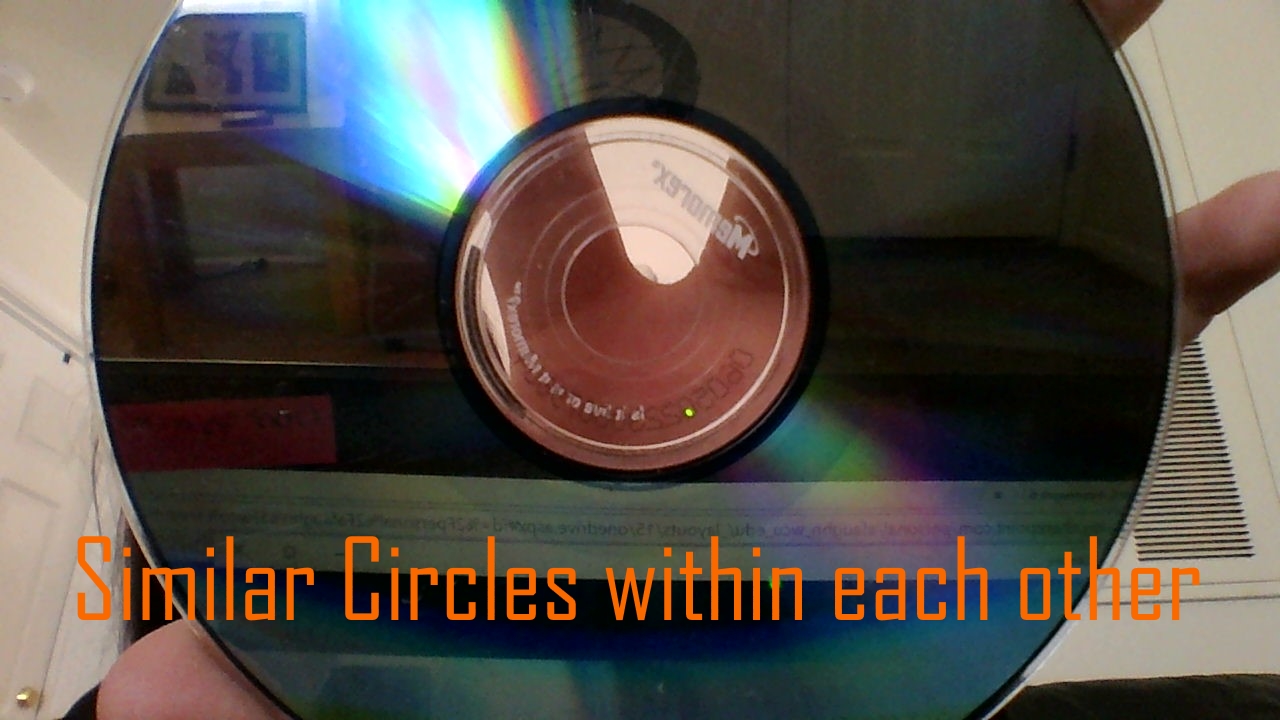
Picture 10: concentric circles
Picture 9: Congruent angles and
proportional sides in various squares
At times, geometry students will also make remarkable observations about similarity, without necessarily knowing they do... a good opportunity to highlight some the need for awareness regarding the mathematics surrounding us. In Picture 9 and 10 for instance students found rather complicated ways of stating the obvious... indeed aren't all circles similar (not just concentric ones as represented in Picture 10)? And what do you think of the squares in Picture 9?

Picture 11: Pier reflection
Picture 12: Composition of transformations

In the pre-calculus class transformations are approached analytically, therefore we add a set of axes in order to describe them in the coordinate plane using function transformations in the expression of the function itself. Pictures 11 and 12 illustrate these manipulations nicely using reflections and shifts, at times combining them. However before getting to such concept mastery these students had to acquire strong knowledge of how transformations can be recognized and composed onto various shapes and curves. The concepts learnt in geometry come in handy when the added difficulty of symbolic expressions comes into play.

The world of transformations is a fascinating and easily accessible one for who gets used to observing and looking for patterns in the world around them. As we enter a new school year, many other kinds of transformations are about to happen in the schools and classrooms around the globe. Some of them one can learn to express using mathematics, others will continue to appear mysterious to a mathematician's mind, but are not less fascinating. Maybe one final point I'd like to emphasize is that there is invariance to be found in the midst of all these changes, some in the shape of lines, points and vectors, others in the form of angles and proportions, and others may see love as the only invariant there needs to be. So love your transformations! And make the most of every day this upcoming school year!


Tuesday, July 25, 2017

The Challenge of Related Rates—By Kathy Jaqua

Word problems are challenging, no matter the age or the mathematical level of the problem solver.  I can almost hear the collective groans of students when I even say word problems, and for calculus students related rates problems produce some of the loudest groans.  For most word problems, the actual process of calculating a solution is not the hard part.  The hard part is setting up the problem to get to the point where calculations can happen.

Related rates is one of the categories of mathematical selfies I always include in a Calculus I project.  Like many categories of word problems in textbooks, related rates problems fall into a few basic types among which are changes in two attributes of a geometric shape such as volume and diameter, and change in length of shadows and speed of an object’s movement.  After a good bit of practice, students can usually learn to solve the standard types of problems, but they often don’t see any relevance of those problems to themselves.  Given that there are typical problems that students are asked to solve, it isn’t surprising that for this part of the project, students notice or recreate those very problems.  What is interesting is how those problems become more personal and how the creation of the mathematical selfie requires that they experience the relationships in a dynamic way.  Textbook illustrations for these problems are obviously static, and so the dynamic relationships between the rates of change within a problem can be hard for students to grasp.  I am always interested to discover what types of examples students see, and how they make this process more relevant to themselves. Here are examples of some of the standard problems and how students translated them.  


1.     Geometric attributes

One typical problem for this type of related rates is pouring some substance at a given rate into a pile.  There is usually a diagram in an industrial setting often with a conveyor belt and a pile of sand.  That’s probably not going to mean a lot to most students.  Making cookies, however, does allow a student to see this exact process in a dynamic way.  It was interesting that two students submitted very similar photos, which probably means that cookies are an important part of college life!  Photo 1 describes the process in a way that indicates the rates of change involved but doesn’t include the units. Photo 2 notes the all-important units of the rates of change, which is always a big step in student understanding.  I am particularly intrigued by the text on the two photos and how it reveals a difference in student understanding.  In photo 1, the student has recreated the diagram of the standard problem, but the two rates described actually represent the same attribute of volume--the change in volume of the sugar being sifted and the change in volume of the sugar in the pile.  This says to me that while the mathematical selfie recreates the diagram of a related rates problem, the text indicates a lack of understanding of the nature of related rates as opposed to a single rate of change.  Photo 2, on the other hand, shows a deeper understanding when it relates two different attributes, rate of change of volume and rate of change of height.  The author even attempts to write the description like a typical textbook question.

     2.  Shadows and motion


This type of problem is usually described with a spot light, a person’s shadow, and motion of either the light or the person.  I often get questions from students of why there is a spot light pointed at a wall, or why a person would be walking between the light and the wall.   This classic question leads to a great use of similar triangles or trig ratios in the solution, but it is very contrived.  A student, however, provides a pertinent example of this very process in photo 3.  Music and concerts are an integral part of student life.  I am really impressed that a student saw the related rates happening in this environment. I also think the problem that the student implies in the description could be a very challenging related rates problem because we can’t really expect the musician to walk in a line on stage, and even if we limit the problem to just one of the shadows that would be cast by these lights, it would still be very challenging given a particular pathway of the musician’s movement.

There are several other typical types of related rates problems, but I’ll stop with these two for this time. The next time I teach Calculus I, I plan to use these mathematical selfies as the basis for some typical related rates problem examples that students may find more relevant, although I will need to put several constraints on the shadows problem or risk a word problem mutiny!